Crowd Fluctuation Theory (CFT)
Baltimore, Maryland, USA
2022-2023, June 2026- Present
Crowd simulation algorithm based on density-functional fluctuation theory (DFFT) to capture both individualistic and group behavior of crowds.

The Problem
Conventional crowd simulations often model individuals explicitly, causing computational cost to increase with the number of simulated agents and making large-scale or real-time simulation expensive.
The Solution at a Glance
Developed a statistical crowd-simulation framework that models crowd-level fluctuations rather than iterating over individual agents, incorporating time-dependent dynamics through physics-based momentum functions.
The Approach
Extended density-functional fluctuation theory to model time-dependent crowd behavior.
Introduced physics-based momentum functions to represent dynamic crowd evolution.
Discretized the continuous formulation into spatial bins suitable for numerical simulation.
Replaced per-agent iteration with statistical approximations calculated at the bin level.
Made computational intensity controllable through spatial bin size.
My Role
Independent Researcher: Developed the theoretical framework, mathematical formulation, discretization approach, and computational implementation independently.
Tools
MATLAB
Anylogic
Unity
Mathematical Modeling
Numerical Simulation

The Results
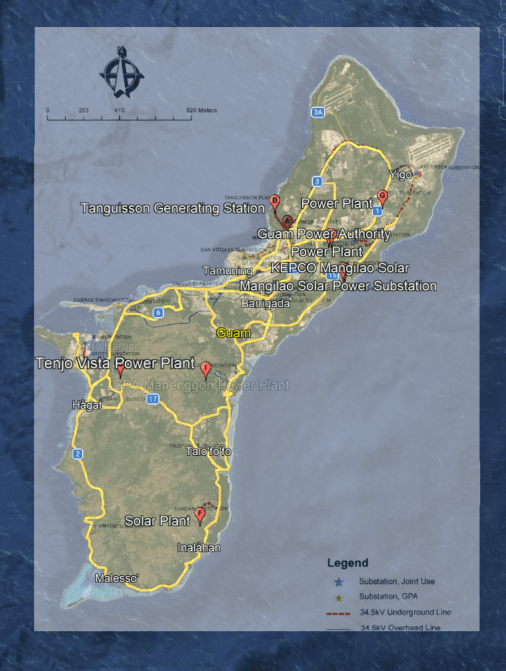
Built a research-grade digital twin of Guam's isolated electrical grid, modeling generators, inverter-based resources, batteries, solar generation, transmission topology, and line characteristics